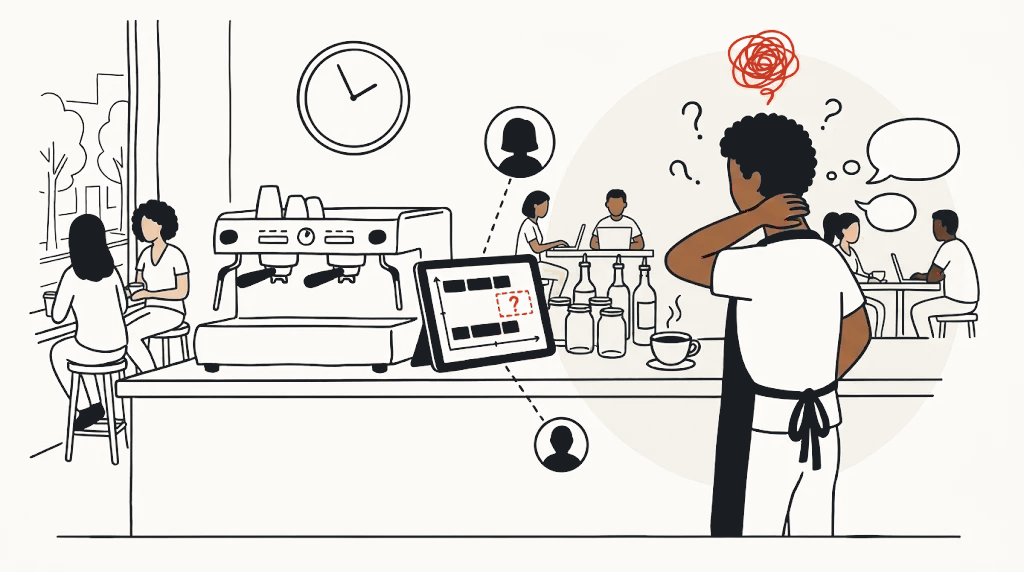
A coffee shop is open 12 hours a day. The promise to customers is the same every morning: the doors open on time, and there's someone behind the counter to take the order and make the drink.
Eleven baristas are on staff, three full-time and eight part-time, with two on the floor for every hour the shop is open. The owner works the bar too, which means there's no spare evening to sit with the schedule.
The day runs on four 6-hour shifts plus a third barista who comes in for two hours to cover breaks, since it's well understood that nobody works the floor alone. That's 26 hours, and 26 is what the budget allows.
Suddenly, a scheduling rethink comes into play: The owner wants to experiment with cold brew and syrups made from scratch, which means two hours of prep in the afternoon lull. The day goes from 26 to 28.
The Constraints
The team has rules it set for itself: two on the floor at all times, nobody alone during a break, only baristas trained on prep do prep, and nobody closes one night and opens the next morning. There's a softer one alongside them — a balance of introvert and extrovert in every pair, so someone on the floor is happy working the register and talking to the line.
The rule that decides how this plays out isn't written down anywhere: the full-timers count on getting their 30 hours in five days.
All of it sits inside the labor rules on breaks and pay that every employer works within.
Where It Collides
The extra two hours are the smallest part of this. They don't fit inside 26, and every way of fitting them moves the cost onto a different person.
Option A keeps the 6-hour shifts and stretches the break cover into a four-hour shift with prep at the end. The full-timers keep their five days. Whoever takes that shift has to be trained on prep.
Option B moves to 5-hour shifts with staggered starts. A five-hour shift doesn't need a break covered, and the afternoon overlap leaves room for prep with coverage on top of it. The full-timers need a sixth day to reach 30 hours, and someone has to close a three-hour shift.
Both come in 14 hours a week over budget.
How a Solver Thinks About It
Scheduling software starts with the shifts that need filling and the people who could fill them. Anyone who'd break a rule drops out, so a barista who closed last night never appears as an option for the next open shift. Put the prep shift in and the hours stop fitting, and it says so immediately, before the owner has spent an evening moving names around.
None of that tells it what matters most to the team. Someone has to tell it whether the budget can flex, what a sixth day costs a full-timer, and whether disturbing the fewest existing shifts beats the extra coverage. Given those priorities, it lays out the workable setups and what each one costs.
What the Software Cannot Decide
The budget can flex, or it can't. A sixth day costs a full-timer something, and only the owner knows what. Whether leaving existing shifts alone matters more than extra coverage is another one only the owner can answer. None of that is in the software. Once it's set, the software lays out the setups and what each one costs.
The five-day week lives in the owner's head and nowhere else. Put it on paper, and the schedule has to respect it every week, which also tells the part-timers their hours bend first when things get tight. Right now it holds because the owner remembers it on the night the schedule gets built.
Both setups run 14 hours a week over budget, so the question underneath all of this is whether the prep work is worth the money at all, or whether the shop keeps making cold brew in the gaps it has today. That depends on what the from-scratch syrups and the extra afternoon coverage bring in.
The Question for the Reader
Every small operation has an expectation like the full-timers get a five-day week that never made it into writing. When you add work to an already full schedule, who absorbs the cost? And has anyone asked them whether they mind?
The Constraint Ledger arrives weekly with one real scheduling collision, worked through to the decisions that stay with people. Subscribe on Substack.
The Constraint Ledger is a product of the team at Calgebra (calgebra.com), which builds scheduling optimization solutions.