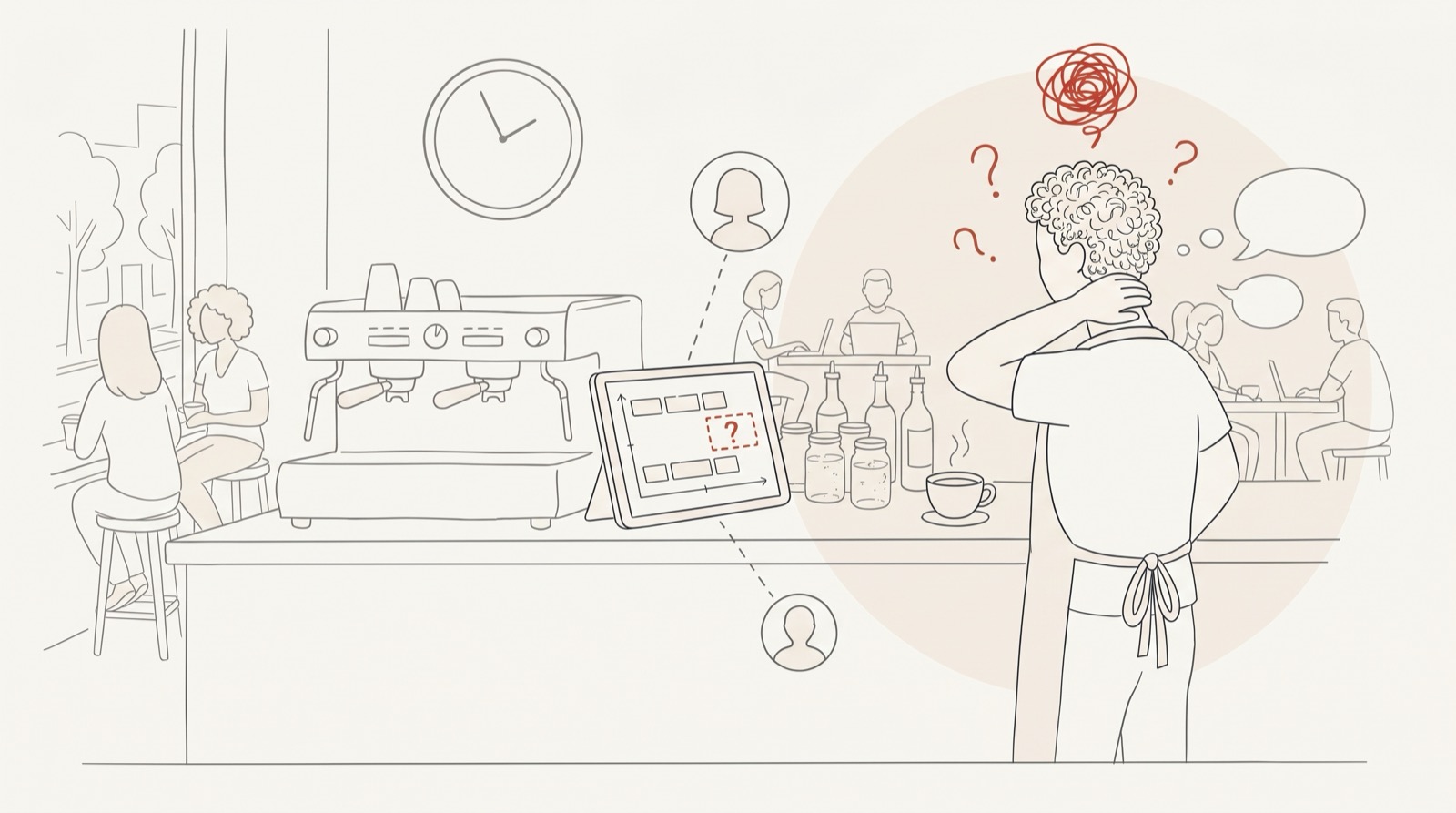
A coffee shop runs on eleven baristas, with two on the floor every hour the shop is open. In the middle of the day a third comes on, just long enough for the other two to take their breaks without the floor ever dropping below two. That overlap is about the only slack the day has. The owner works the bar too, so there's no spare evening to sit with the schedule.
Even on a normal week, building it is the hard part. Eleven people, two at a time, every one with their own availability, and a handful of rules that all have to hold at once.
It all interlocks, and that's the part that doesn't show. There's no slack in it. Move a single piece and the rest has to move with it.
Then a barista can't make a shift, and it's too late to plan around it. One of the two people on the Thursday close calls out. On paper the shift was covered. Now it's not, and the owner is on bar when they find out.
The Constraints
The rules are the team's own, and most of them were never written down. They live in the owner's head, and they are the difference between a schedule that works and one the team resents. Here is the whole set. There is also a smattering of labor law that could make this messier still, and it is not worth untangling here, where things are already messy enough.
The Constraint Ledger, Entry 03: constraint card
What every schedule has to respect
| Constraint | Type | Source | Cost of violation |
|---|---|---|---|
| Two baristas on the floor for every hour the shop is open | Hard | Team rule | One barista runs the floor alone while the line grows |
| A third barista on the midday overlap so breaks get taken | Hard | Team rule | Breaks get skipped, or the floor drops to one |
| Only baristas trained on a task do that task | Hard | Team rule | A close run by someone never trained to close |
| Nobody closes one night and opens the next morning | Hard | Team rule | A barista opens the shop short on sleep |
| Breaks, pay, and schedule notice follow the labor rules | Hard | Law and regulation (context) | Legal exposure and back pay |
| The week stays inside the labor budget | Soft | Budget | Every added hour comes out of the shop's margin |
| Every pair balances an introvert and an extrovert | Hidden | Unwritten expectation | Nobody on the floor is at ease on the register and the line |
Where It Collides
The person who dropped was one half of the Thursday close. The other half is still on it, an extrovert, so whoever steps in has to be an introvert to keep the pair balanced. That is only the start of it. To take the close, they also have to clear every one of these at once:
To cover the Thursday close, a barista must
- be trained to close,
- be free on Thursday evening,
- be an introvert, since the other closer is an extrovert,
- not be opening Friday morning (nobody closes then opens), and
- have room under their weekly hours, so the budget holds.
Here is everyone the owner has to work with.
| Barista | Trained to close | Personality | Thursday evening | Friday morning | Weekly hours |
|---|---|---|---|---|---|
| Barista 1 | yes | extrovert | free | free | at the cap |
| Barista 2 | yes | extrovert | on the Thursday close | free | room to spare |
| Barista 3 | yes | introvert | off | free | room to spare |
| Barista 4 | yes | introvert | free | opening | room to spare |
| Barista 5 | no | extrovert | free | free | room to spare |
| Barista 6 | yes | introvert | free | free | at the cap |
| Barista 7 | yes | introvert | called out | — | — |
| Barista 8 | no | introvert | free | off | room to spare |
| Barista 9 | yes | extrovert | free | opening | at the cap |
| Barista 10 | yes | introvert | off | off | room to spare |
| Barista 11 | no | extrovert | free | free | room to spare |
There's an answer in here. It just isn't the first one you land on, and finding it means giving up the idea that you only have to move one person.
Your Move
That's everything the owner knows, standing at the bar between orders, with no evening to try ten versions. The scheduling app will post whatever grid they hand it. It won't help them find a better one, and it won't tell them what a last-minute hole really costs. We build software that works through trade-offs like these for a living, which is why we'd rather hear how you'd call it first.
So who covers the Thursday close, and what else has to move to make it legal? Work it out before you open the answer, and tell us in the comments what you would recommend.
Show how it resolves
Start by ruling people out. You need an introvert who is trained to close and actually free Thursday evening. That removes every extrovert (Baristas 1, 2, 9, 11), everyone not trained to close (5, 8, 11), and anyone off Thursday (3, 10). Two names are left: Barista 4 and Barista 6.
Barista 6 looks like the answer — introvert, trained to close, free Thursday. But Barista 6 is already at the weekly hours cap, so taking the close blows the budget. Out.
That leaves Barista 4, who clears everything except one thing: they're opening Friday morning, and taking the Thursday close would make it close-then-open. The only way through is to move Barista 4's Friday opening to someone else. That opener has to be an introvert too, since their Friday partner (Barista 9) is an extrovert, and they have to be trained to open, free Friday morning, and not closing Thursday night. The only person who fits is Barista 3.
The answer: Barista 4 takes the Thursday close, and Barista 3 picks up Barista 4's Friday opening. One call-out, two moves, and it is the only combination that breaks no rule.
The Constraint Ledger arrives weekly with one real scheduling collision, handed to you to solve. Subscribe on Substack.
The Constraint Ledger is a product of the team at Calgebra (calgebra.com), which builds scheduling optimization solutions.